Multi-phase ELAStic Aggregates (MELASA) is a new web-based software tool for modelling anisotropic elastic properties of lamellar composites. It implements a linear-elasticity method by Grimsditch and Nizzoli (1986), originally developed for superlattices of any symmetry. Resulting elastic properties are visualized in the form of directional dependencies of selected elastic characteristics (Young’s modulus and linear compressibility).
M. Friák, D. Lago, N. Koutná, D. Holec, T. Rebok, M. Šob: "Multi-phase ELAStic Aggregates (MELASA) software tool for modeling anisotropic elastic properties of lamellar composites". Comput. Phys. Commun., 247, 106863 (2020). DOI: 10.1016/j.cpc.2019.106863
Neda Abdoshahi with her husband Masoud Taheri have become proud parent of little Maria. We wish you three together a happy life and congratulate to you!
Using DFT calculations we showed that N alloying to the non-metal sublattice in TaC improves its ductility. The material has been subsequently synthesised using PVD and characterised using micromechanical testing showing that TaC-based materials are harder than TiN- and CrN-based systems while exhibiting similar fracture toughness.
T. Glechner, R. Hahn, T. Wojcik, D. Holec, S. Kolozsvári, H. Zaid, S. Kodambaka, P.H. Mayrhofer, H. Riedl: "Assessment of ductile character in superhard Ta-C-N thin films". Acta Mater., 179, 17–25 (2019). DOI: 10.1016/j.actamat.2019.08.015
Intermetallics 2019 conference took place in Bad Staffelstein, Germany from 30th September till 4thOctober 2019 in the premises of former cloister Kloster Banz. David has presented a talk on "Impact of Mo and disorder on diffusionless transformations in TiAl intermetallic alloys" and a poster "Alloying impact on phase stability in ZrAl3". Both works attracted attention and stimulated further interaction with other colleagues.
Dominik Nöger and Sabrina Gehringer have married last weekend. We wish you all the best on your journey together!
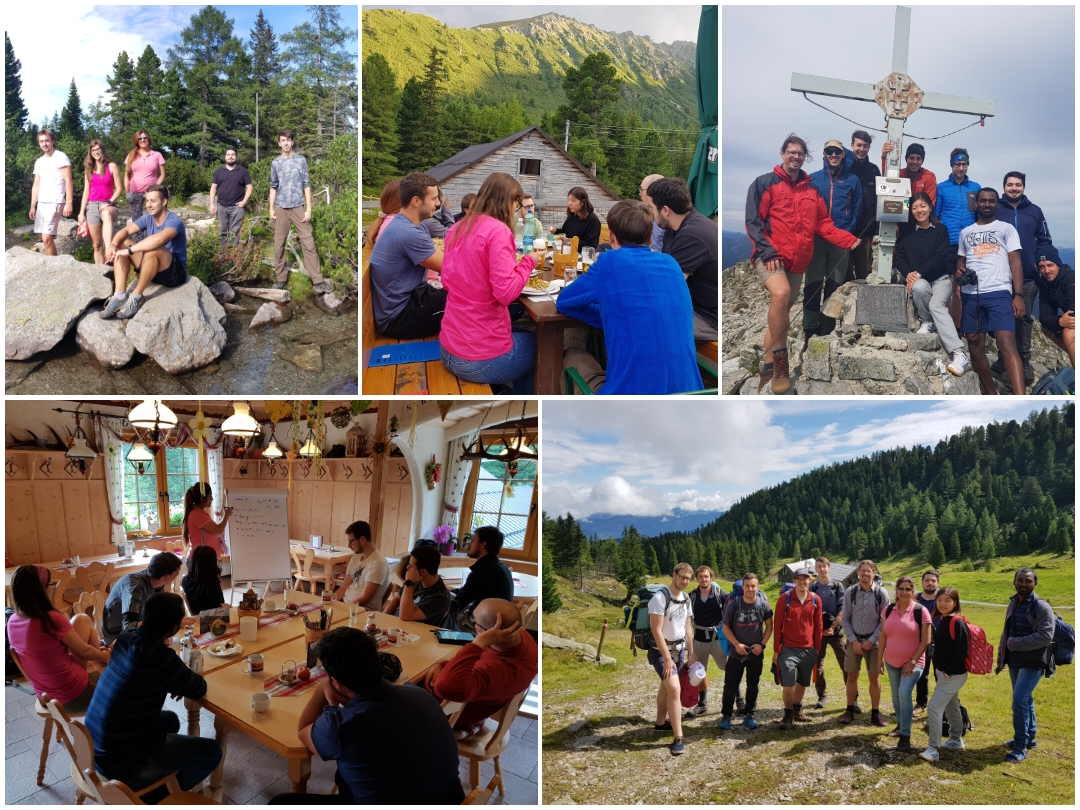
The 1st group retreat took place during 6th–8th August 2019 at Edelrautehütte. We have enjoyed stimulating "off-line" environment with gorgeous mountain sceneries for numerous and lengthy discussions, planning future projects, updating about current progress and team binding together.
MSMF-9 (Materials Structure & Micromechanics of Fracture) conference took place in Brno, Czech Republic. During this three days meeting (June 26-28, 2019), works of Lukas Löfler and Lukas Hatzenbichler on mechanical properties of superlattices were presented, together with co-authored contributions from colleagues from TU Wien and IPM Brno.
In this ab initio study we predict a remarkable sensitivity of vacancy formation energies, their volumes and changes of local magnetic moments of neighbouring Fe atoms on the chemical composition around the vacancy.
I. Miháliková, M. Friák, N. Koutná, D. Holec, M. Šob: "An Ab Initio Study of Vacancies in Disordered Magnetic Systems: A Case Study of Fe-Rich Fe-Al Phases". Materials, 12(9) (2019). DOI: 10.3390/ma12091430
Extended approach based on quasi-harmonic approximation was applied to two non-cubic phases, namely to a (slightly) tetragonal γ-TiAl and to hexagonal α2-Ti3Al. Here we have compared traditional QHA calculation with the cell-shape optimised only at 0 K with novel "temperature-optimised cell shape" approach in which, for example, the c/a may differ at finite temperature from that at 0 K for the same specific volume. While the two approaches yield almost identical results for the α2-Ti3Al phase, in the case of γ-TiAl the new approach seem to be essential in order to obtain thermal properties in agreement with experiment.
D. Holec, N. Abdoshahi, S. Mayer, H. Clemens: "Thermal Expansion and Other Thermodynamic Properties of α2-Ti3Al and γ-TiAl Intermetallic Phases from First Principles Methods". Materials, 12(8) (2019). DOI: 10.3390/ma12081292
Using DFT calculations, we identified TiN/WN0.5 superlattices as a feasible system with a supposed potential for ductility clearly exceeding that of the monolithic constituents as well as many other established TMNs. These predictions were confirmed experimentally by showing peaks in hardness and toughness as functions of the superlattices bi-layer period. Finally, applying information from DFT and a continuum-mechanics model for effective elastic properties, we were able to propose a complicated distribution of vacancies near the interfaces, leading to a stabilisation of phases with excellent mechanical properties, but not existing in a bulk form.
J. Buchinger, N. Koutná, Z. Chen, Z. Zhang, P. Mayrhofer, D. Holec, M. Bartosik: "Toughness enhancement in TiN/WN superlattice thin films". Acta Mater., 172, 18–29 (2019). DOI: 10.1016/j.actamat.2019.04.028
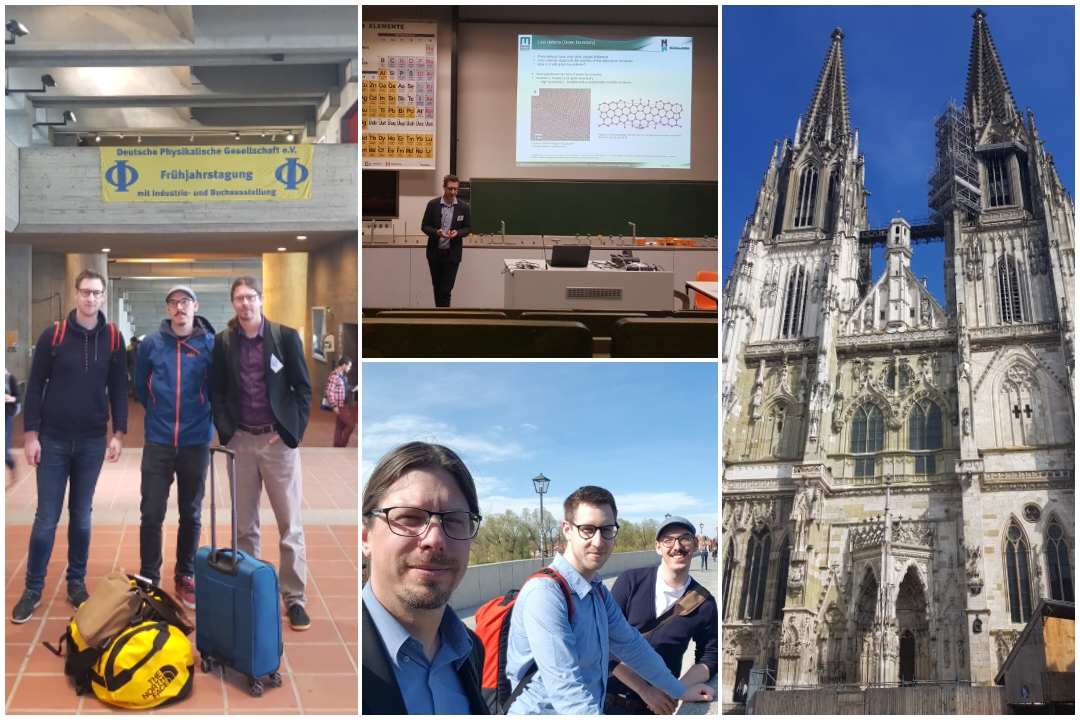
DPG Spring Meeting 2019 took place in Regensburg (Germany) from March 31 to April 5, 2019. Our group was well represented with 5 contributed talks and additional 4 co-authored presentations. Next to the interesting scientific programme and exciting discussions and networking, Lukas, Dominik and David managed to spare some time also for the city tour.
A great day out! Despite the summer-like temperatures we were able to enjoy morning skiing. Fangyu made her first steps (and turns) and by the lunch time, she was able to ski a (very) blue slope down on her own, accompanied by cheering Lukas, Dominik and David.