Our research combines first-principles calculations, machine-learning interatomic potentials, atomistic simulations and thermodynamic modelling, always in close contact with experimental partners. Click on a project for details on the team, partners, funding and publications.
 Order in Refractory-Based Complex Concentrated Alloys (OrCCA)Short- and long-range chemical order (bcc/B2) in refractory-based complex concentrated alloys and its impact on mechanical properties, studied with DFT and machine-learning potentials.
 Thermal and Oxidation Properties of Refractory High-Entropy Alloys (TOP-RHEA)Fundamental research on the phase stability of refractory high-entropy alloys using first-principles calculations and machine-learning potentials, together with Plansee SE.
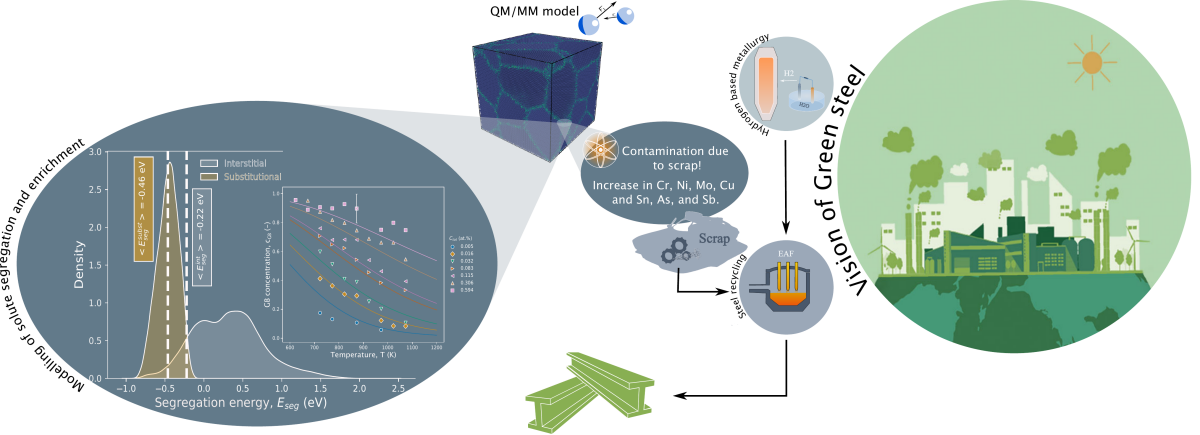 Christian Doppler Laboratory for Knowledge-based Design of Advanced Steels (CDL-KnowDAS)Scale-bridging design of steels with a high scrap fraction: how tramp and trace elements affect microstructure and properties, from ab initio calculations to components.
| 10/2023–03/2025 | TRIP and TWIP as Key Tools to Design Advanced AM Alloys for Aviation Structures (T3Design) Ti alloys for wire-arc additive manufacturing of aviation structures that use the TRIP and TWIP effects for high strain hardening; ab initio modelling of the deformation mechanisms. |
| 10/2021–09/2024 | Additive Manufacturing of Non-Weldable Nickel-Base Superalloys: Process, Microstructure and Mechanical Properties (AMnonWeldSuperAlloys) Hot cracking along grain boundaries in additively manufactured Ni-base superalloys with a high γ′ fraction: the role of micro-alloying elements, with ab initio modelling of grain-boundary segregation. |
| 01/2019–12/2022 | Diffusion Control of Friction-Reducing Nanocomposite Materials Controlled release of vanadium from TiSiVN nanocomposite coatings for self-lubricating tools: diffusion in TiN, amorphous SiN and across interfaces from ab initio calculations and machine-learning potentials. |
| 11/2017–10/2022 | Impact of Interfaces on Mechanical Properties of Hard Coating Materials Superlattice hard coatings: how interfaces control strength and fracture toughness, studied with DFT and molecular dynamics together with micromechanical experiments at TU Wien. |
| 06/2017–05/2021 | Atomistic Principles of Martensitic and Ordering Transformations at Finite Temperatures (MOTIF) Quantum-mechanical calculations of martensitic and ordering transformations in rapidly cooled TiAl+Mo intermetallic alloys. |