Lightweight intermetallic γ-TiAl-based alloys contain, when rapidly cooled, (meta)stable “frozen-in” phases that do not exist in thermodynamic equilibrium and are difficult to characterise experimentally. MOTIF used quantum-mechanical calculations to understand the processes behind them, focusing on TiAl alloyed with Mo, a known stabiliser of the β/βo phase that helps to tune the mechanical properties. The fundamental aim was a methodology for obtaining structural and mechanical properties of (meta)stable, chemically complex phases; two complementary approaches were used, supercells with explicitly distributed atoms and the Green’s-function-based coherent potential approximation.
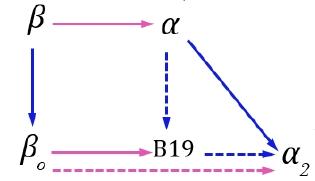
The calculations showed that Mo stabilises the β/βo phase while destabilising the other phases, and that it improves the ductility of the β and hexagonal Ti0.5Al0.5 phases; dedicated experiments confirmed these predictions. The structural models and effective interactions between the species were then used to study martensitic (displacive) and ordering transformations. Displacive transformations between ordered phases proceed mostly without a barrier, i.e. spontaneously, which excludes an equilibrium coexistence of βo and γ phases of the same composition; more than about 8 at.% Mo is needed to stabilise the β/βo phase against this transformation. Chemical disorder, in contrast, introduces a small barrier and thus effectively stabilises β-TiAl with a small amount of Mo. Monte Carlo simulations showed that the ordering temperature increases with the Mo content, and a new B22 phase was proposed as the bcc-based ground state of Ti0.5Al0.5.
To obtain a martensitic microstructure, the Mo content therefore has to be balanced: more Mo stabilises the βo phase, but also gives a too large driving force for ordering, which leads to phase separation instead of a martensitic microstructure. In addition, the thermal expansion and other thermodynamic properties of γ-TiAl and α2-Ti3Al were predicted from first principles.
Neda Abdoshahi, Lukas Hatzenbichler, Manuel Kisilak, David Holec
Austrian Science Fund (FWF), project P 29731-N36.