← All projects
Diffusion Control of Friction-Reducing Nanocomposite Materials
Completed project, 01/2019–12/2022
 © CMS group, MUL
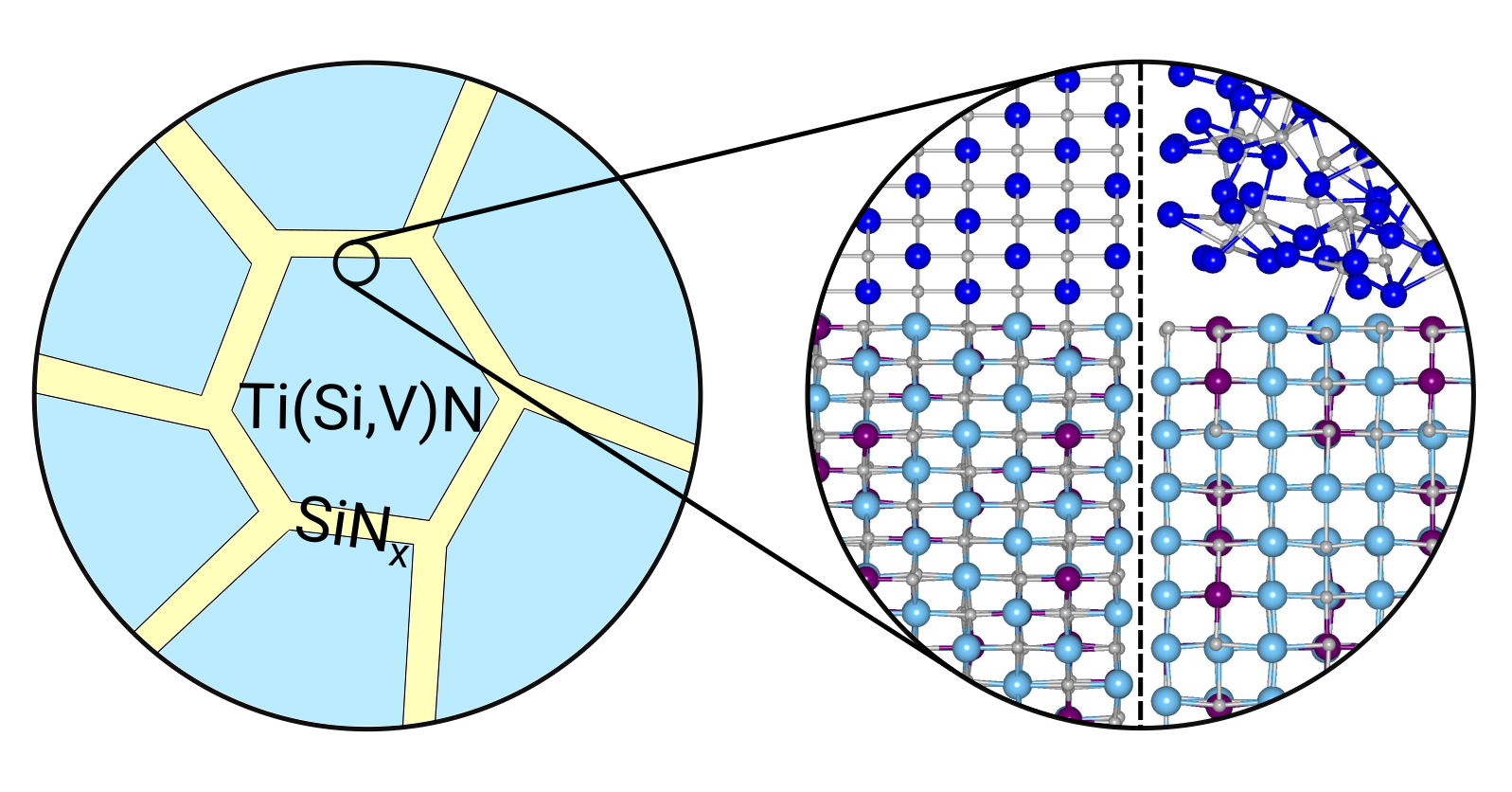
Hard nanocomposite coatings protect tools against wear at temperatures up to 1000 °C, but high contact friction often requires lubricants, with significant environmental impact. Vanadium added to the coatings forms a solid VOx lubricant above about 700 °C and reduces friction and wear, but its rapid out-diffusion towards the surface limits the long-term performance. This joint project of Montanuniversität Leoben and the Czech Technical University in Prague combined theory and experiment to control the sustained release of vanadium from TiSiVN nanocomposite coatings through their microstructure and composition.
Our group studied the diffusion mechanisms in TiN crystallites, in the amorphous SiN matrix and across TiN/V/SiN interfaces. First-principles calculations showed that V migration barriers along TiN grain boundaries are about half those in bulk TiN, and that amorphous SiN, despite a large scatter of barriers, offers pathways with lower effective barriers than TiN, so V diffuses faster in SiN than in TiN. Migration barriers and defect energetics of 19 transition metals in TiN were published as a database for modelling mass transport in TiN-based materials; they showed that smaller atoms do not necessarily diffuse faster, because the barriers depend on the bonding of the impurity d-states with the host. A side study on high-entropy nitrides showed that increasing chemical complexity lowers the migration barriers, contrary to the “sluggish diffusion” core effect, and that lattice distortions correlate with the activation energies.
The originally proposed coupled quantum-mechanics/molecular-mechanics (QM/MM) technique was implemented in pyiron and applied to segregation at α2/γ interfaces in TiAl alloys in a parallel project (Gehringer et al., Phys. Rev. Mater. 2023), but it was not used for the diffusion studies of this project: machine-learned interatomic potentials turned out to be more stable and flexible and became the method of choice. A moment tensor potential was, to our knowledge for the first time, parametrised for a multi-component amorphous system and predicted the structure and mechanical properties of amorphous silicon nitride, validated by experiments. Guided by the calculations, the partners grew coatings that lasted longer in dry cutting than conventional TiSi(V)N coatings, and designed nacre-like TiSiN coatings with enhanced fracture toughness, also in an industrial coating system.
Team
Ganesh Kumar Nayak, David Holec
Partners
- Rostislav Daniel (project leader), Juraj Todt, Michal Zítek, Jozef Keckes (Department of Materials Science, Montanuniversität Leoben)
- Paolo Nicolini, Tomáš Polcar, Filipe Fernandes (Czech Technical University in Prague, Czech Republic)
Funding
Austrian Science Fund (FWF), project I 4059-N36, and Czech Science Foundation (GAČR), joint FWF–GAČR project.
Selected publications
- G. Nayak, P. Srinivasan, J. Todt, R. Daniel, P. Nicolini, D. Holec: "Accurate prediction of structural and mechanical properties on amorphous materials enabled through machine-learning potentials: A case study of silicon nitride". Comput. Mater. Sci., 249(113629), 113629 (2025). DOI: 10.1016/j.commatsci.2024.113629
- N. Schalk, Y. Moritz, G. Nayak, D. Holec, C. Hugenschmidt, V. Burwitz, L. Mathes, M. Schiester, C. Saringer, C. Czettl, M. Pohler, C. Mitterer, M. Tkadletz: "Nanocomposite versus solid solution formation in the TiSiN system". Acta Mater., 275, 120063 (2024). DOI: 10.1016/j.actamat.2024.120063
- G. Nayak, A. Kretschmer, P.H. Mayrhofer, D. Holec: "On correlations between local chemistry, distortions and kinetics in high entropy nitrides: An ab initio study". Acta Mater., 255, 118951 (2023). DOI: 10.1016/j.actamat.2023.118951
- G. Nayak, D. Holec, M. Zelený: "Impact of d-states on transition metal impurity diffusion in TiN". Sci. Rep., 13(1), 8244 (2023). DOI: 10.1038/s41598-023-34768-7
- M. Hans, Z. Czigány, D. Neuß, J.A. Sälker, H. Rueß, J. Krause, G.K. Nayak, D. Holec, J.M. Schneider: "Probing the onset of wurtzite phase formation in (V, Al) N thin films by transmission electron microscopy and atom probe tomography". Surf. Coat. Technol., , 128235 (2022). DOI: 10.1016/j.surfcoat.2022.128235
- G. Nayak, M.N. Popov, D. Holec: "Pressure- and temperature-dependent diffusion from first-principles: A case study of V and Ti in a TiN matrix". Surf. Coat. Technol., 422, 127491 (2021). DOI: 10.1016/j.surfcoat.2021.127491
- D.M. Holzapfel, D. Music, M. Hans, S. Wolff-Goodrich, D. Holec, D. Bogdanovski, M. Arndt, A.O. Eriksson, K. Yalamanchili, D. Primetzhofer, C.H. Liebscher, J.M. Schneider: "Enhanced thermal stability of (Ti,Al)N coatings by oxygen incorporation". Acta Mater., 218, 117204 (2021). DOI: 10.1016/j.actamat.2021.117204
- Z. Chen, Y. Zheng, L. Löfler, M. Bartosik, G. Nayak, O. Renk, D. Holec, P.H. Mayrhofer, Z. Zhang: "Atomic insights on intermixing of nanoscale nitride multilayer triggered by nanoindentation". Acta Mater., 214, 117004 (2021). DOI: 10.1016/j.actamat.2021.117004
- D. Gehringer, L. Huber, J. Neugebauer, D. Holec: "Segregation to α2/γ interfaces in TiAl alloys: A multiscale QM/MM study". Phys. Rev. Mater., 7(6), 063604 (2023). DOI: 10.1103/PhysRevMaterials.7.063604