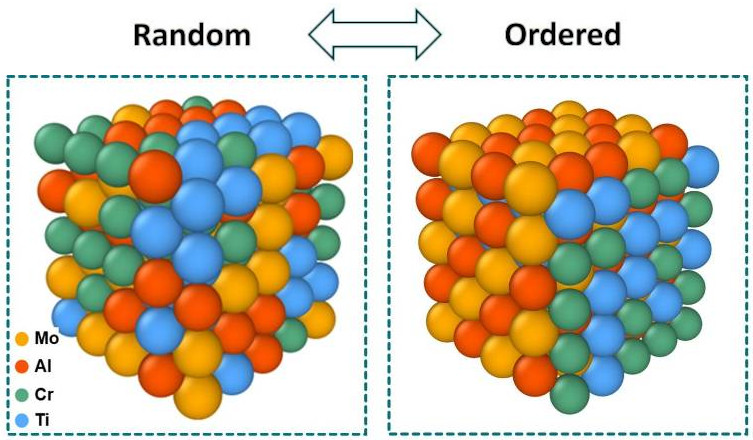
Refractory-based complex concentrated alloys (R-CCAs), also known as refractory high-entropy alloys, are candidates for structural materials operating at temperatures beyond the limits of Ni-base superalloys. Many of them show a two-phase microstructure of a disordered bcc (A2) matrix and ordered B2 regions, similar to the γ/γ′ microstructure of superalloys. Their unexpected mechanical properties have been linked to lattice distortions and to chemical short-range order (SRO) and long-range order (LRO). Quantifying order in alloys with five or more principal elements is, however, difficult both experimentally and computationally, so its exact influence on the properties is often unclear. A key question is whether structure–property relationships established for dilute and binary or ternary solid solutions still apply to these alloys.
We address this question computationally, using TiAlCrMoNb as a model system. Density functional theory gives the thermodynamic stability of bcc and B2 variants as a function of composition. Universal machine-learning interatomic potentials, benchmarked against DFT, make hybrid Monte Carlo/molecular dynamics simulations of large, chemically complex supercells feasible; from these we obtain Warren–Cowley SRO parameters, sublattice occupations and order–disorder transition temperatures, and study how ordering affects structural and mechanical properties and alloying trends.
The project is a collaboration with the group of Petra Spörk-Erdely at TU Graz, which works on these alloys experimentally, including laser powder bed fusion with in-situ alloying and synchrotron diffraction. The calculations help to interpret the measured structures and pair distribution functions.
Personal grant of the China Scholarship Council (CSC) for Jiyao Zhang; otherwise carried out without dedicated project funding.