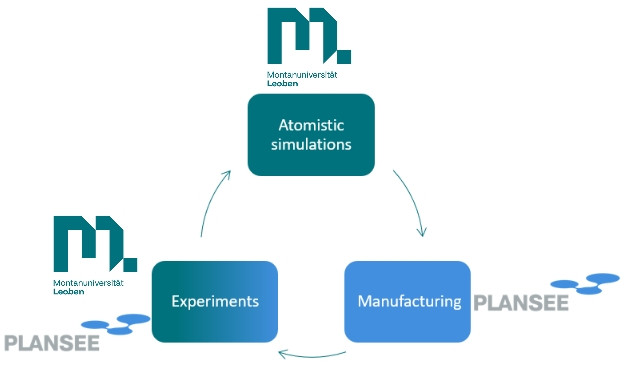
Refractory high-entropy alloys (RHEAs) offer exceptional high-temperature strength and corrosion resistance and are candidates for aerospace, nuclear, furnace and rocket-nozzle applications. Together with our industrial partner Plansee SE we carry out fundamental research on the thermodynamic stability of RHEAs. The number of possible element combinations is huge, so computational methods are used to explore the compositional space and to understand which alloys form stable solid solutions.
For an RHEA to keep its properties, it must form a stable solid solution and must not decompose into intermetallic phases. We have developed an automated workflow that compares the formation enthalpy of the solid solution, calculated with density functional theory (DFT), with that of all possible combinations of decomposition products taken from the Materials Project database, and have applied it to Mo–Nb–Ta–W–X alloys (X = Cr, Si, Al, Zr, Ti). Universal machine-learning interatomic potentials (GRACE, Matlantis, FAIRChem) are benchmarked against DFT and then used for larger and chemically more complex systems.
A case study is the binary Ta–W system: the experimental phase diagram shows a solid solution at all temperatures, whereas DFT predicts ordered phases. Combining DFT, machine-learning potentials, and magnetron-sputtered thin films prepared and characterised by our partners at Montanuniversität Leoben, we showed that B2-TaW and D03-TaW3 are stable only at and below room temperature, which reconciles the ab initio and CALPHAD assessments. Further topics are the oxides of refractory metals and the segregation of elements to grain boundaries in the TiZrHfNbTa (Senkov) alloy and its effect on mechanical properties.
Klemens Lechner, Ambroise Dumont, David Holec
Former members: Nico Mandlberger
Plansee SE